
How to Measure Patio Cushions for Replacement Covers
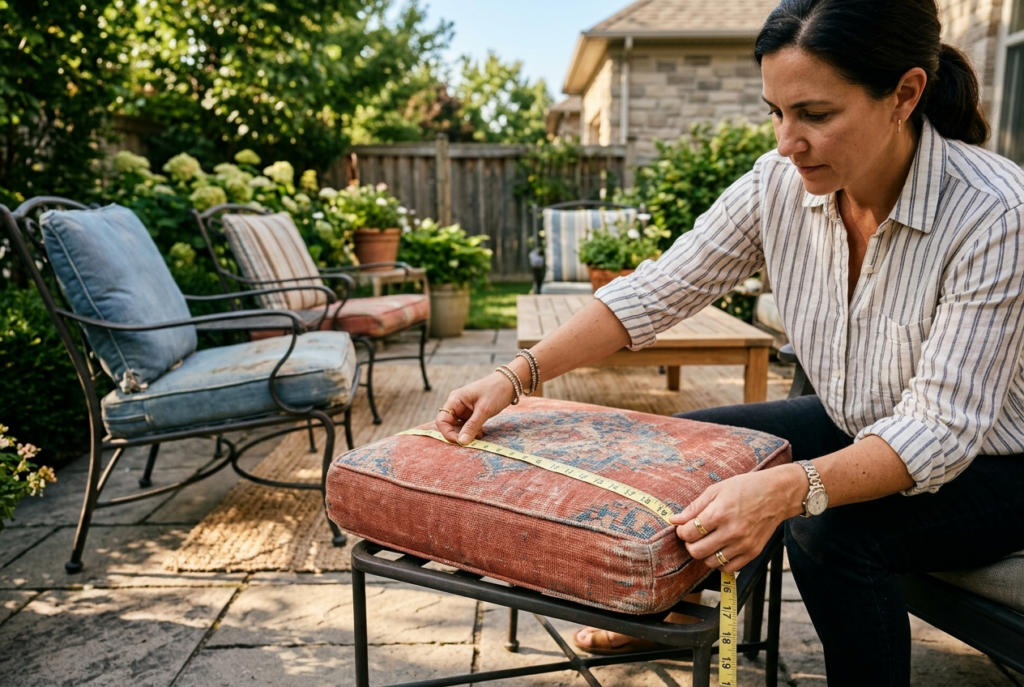
Patio cushion covers that don’t fit right are like expensive bags of frustration. They bunch, they slide, and no amount of tugging fixes them. The problem almost always starts the same way: someone didn’t know how to measure patio cushions.
Getting the right fit for replacement patio cushion covers essentially comes down to getting accurate measurements. Custom-fit covers sit clean and snug, protect the cushion underneath, and make the entire patio look like someone put real thought into it.
The good news is that measuring outdoor furniture cushions correctly isn’t complicated. It just requires a little technique and patience. This guide walks you through everything: dimensions, cushion shapes, common mistakes, and how to get your measurements ready to order.
Key Takeaways
- Always measure the cushion insert itself, without the existing cover.
- Every cushion needs three dimensions: width, length, and thickness. Don’t skip thickness.
- Measure twice, order once. Round to the nearest quarter-inch.
- Cushion shape matters. Before you measure, identify whether yours is square, rectangular, a wedge, round, or has rounded corners. Finally, a chance to use all that stuff you learned in kindergarten!
- Take photos from directly above each cushion. This is the most useful reference you can have when ordering.
- If the cushion’s foam is still in good shape, replacement covers are always more cost-effective than replacing the entire cushions.
Why Accurate Cushion Measurements Matter
A cover that fits correctly does more than look good. It sits flat, moves with the cushion, and stays in place through the whole season. A cover that’s too large bunches and shifts constantly. One that’s too small pulls the seams and strains the fabric.
But there is still the matter of appearance. A tailored-looking patio is less about having expensive furniture and more about having a setup that looks intentional. Covers that fit right do that work for you. Covers that don’t fit draw the eye for the wrong reasons.
Tools You’ll Need Before Measuring
You don’t need anything specialized to measure patio cushions. A few basic items will get you through the whole process:
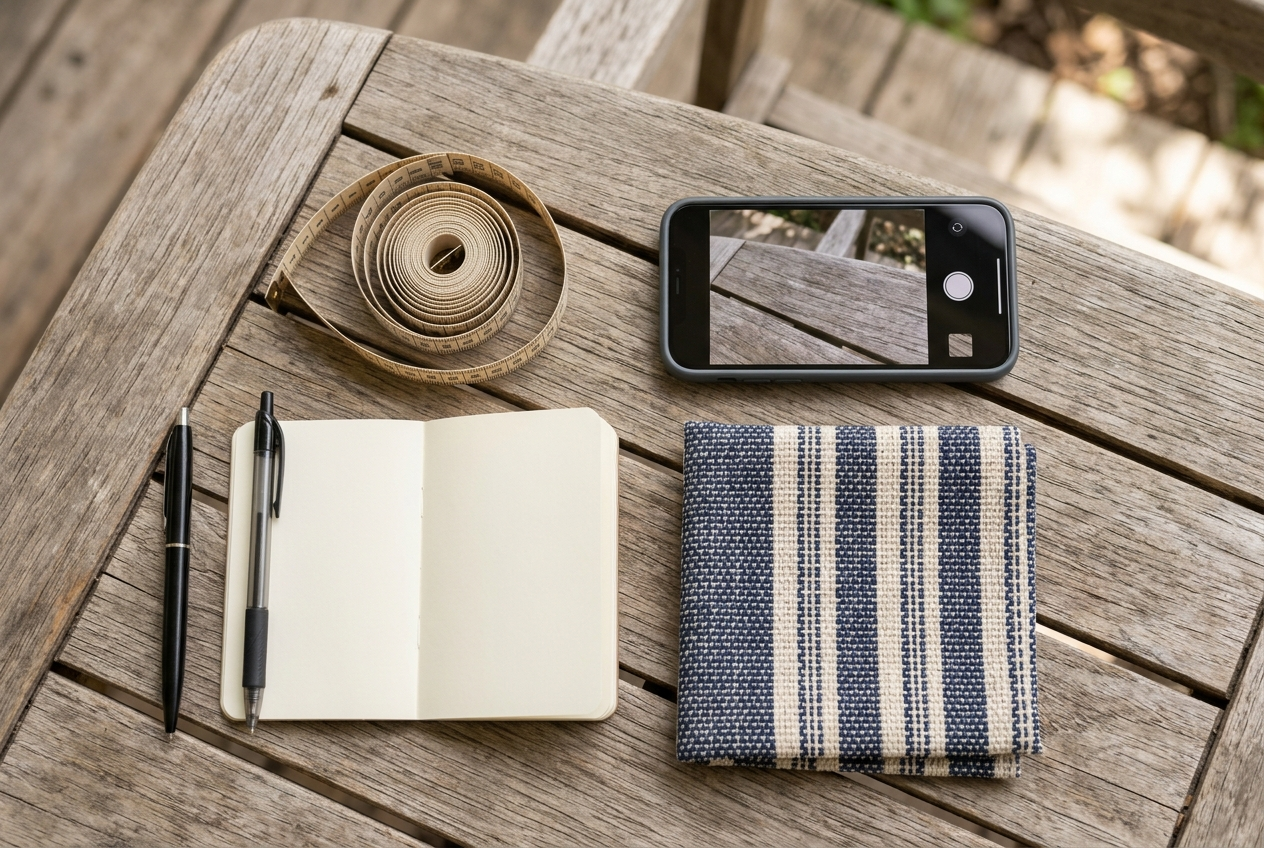
- A flexible tape measure, also known as a soft tailor’s tape, is ideal because it can follow curves and rounded corners that a rigid metal tape can’t. A standard retractable tape works fine for straight-edged cushions.
- Something to write with. You’ll forget the numbers! Write measurements down immediately.
- Your phone’s camera. A photo taken directly from above each cushion gives you a reference for shape and corner style that’s often clearer than any written description.
- A flat surface. Remove the cushion from the furniture and lay it flat to measure! Cushions that are still on the chair shift, and that skews the numbers.
Understanding Cushion Dimensions
Before you pick up the tape, it helps to know what each measurement means. Outdoor cushion dimensions include more than just length and width.
| Measurement | What It Means | How to Measure |
|---|---|---|
| Length | Front-to-back dimension | Measure the longest side from front edge to back edge |
| Width | Side-to-side dimension | Measure straight across the cushion face |
| Thickness / Depth | Cushion height | Measure from the top surface to the bottom surface at the fullest point |
| Radius | Rounded corner curvature | Note the curve at each corner; measure from where the curve starts to where it ends |
| Taper | Difference in cushion dimensions front to back | Measure widest and narrowest points separately |
Step-by-Step Guide to Measuring Patio Cushions
Measuring Seat Cushions
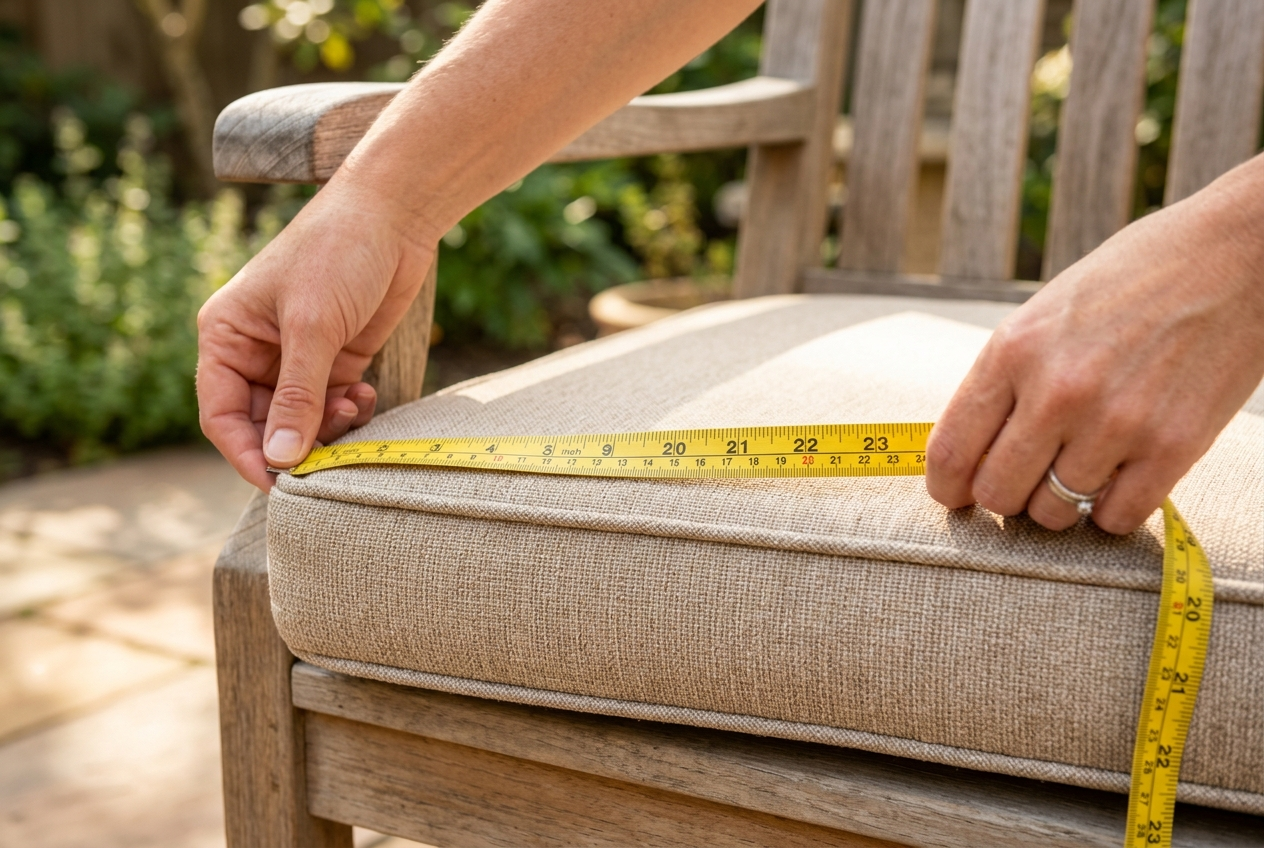
Seat cushions are what most people are measuring for, and they require all three core dimensions: width, length, and thickness.
Start with width. Measure straight across the seat cushion from one side to the other at the widest point. On most cushions, that’s across the middle or front edge. If your chair has arms, measure from the inside of one arm to the inside of the other. That’s the space the cover needs to fit.
For length, measure from the front edge of the cushion straight back to the rear edge. Keep the tape level and in a straight line.
For thickness, measure from the top of the cushion down to the bottom. Measure at the fullest point, which is typically in the center. If the cushion has compressed from use—which is very common—measure where the foam is still at its natural height, not where it’s been flattened.
Measuring Back Cushions
Back cushions differ from seat cushions mainly in proportion and how they attach. They’re typically taller than they are wide, and they often have a looser, softer feel because many are fiber-filled rather than solid foam.
Measure the width across the back cushion at its widest point, and measure the height from the bottom edge to the top edge. For thickness, check whether the cushion has a consistent depth or tapers from bottom to top (outdoor back cushions often do).
If your back cushion is attached to the chair frame with ties or clips, measure the cushion itself, not the visible portion after it’s mounted. The full cushion dimensions are what the cover needs to fit.
Some patio chairs have an arched or curved back frame, and the back cushion follows that shape. If yours does, note the shape. A photo from directly in front of the chair captures this clearly.
Recording Measurements Correctly
Measure each cushion twice. The second measurement almost always catches something the first one missed. If it does, go ahead and measure a third time! Measure thrice, order once.
Round to the nearest quarter-inch. Most cover orders are placed in quarter-inch increments, so exact fractions like 18 and three-eighths don’t quite translate. Round to the nearest 18.25″ or 18.5″.
Write each cushion’s dimensions in a consistent format: Width x Length x Thickness. Label which cushion and which piece of furniture each set of numbers belongs to. If you’re ordering covers for a full patio set, a simple notebook page with each piece labeled can save you a lot of confusion.
You can check your measurements against our size chart before ordering to confirm your dimensions.
How to Measure Different Cushion Shapes
Outdoor furniture doesn’t come in one standard shape, and neither do its cushions. Knowing what shape you’re dealing with before you measure prevents a lot of confusion.
| Cushion Shape | Key Measurements Needed | Special Considerations |
|---|---|---|
| Square | Length, width, thickness | Simplest shape to measure. All sides equal |
| Rectangle | Length, width, thickness | Confirm which dimension is longest before writing it down |
| Round | Diameter, thickness | Measure across the center point at its widest |
| Curved | Length, width, radius | Note corner curvature at each rounded corner |
| Wedge | Front width, rear width, depth | Measure both the wide and narrow ends. They’re different |
| T-Shaped | Multiple widths and lengths | Sketch the shape and label each measurement separately |
Measuring Cushions with Unique Features
Rounded Corners
Rounded corners are one of the most common sources of poor fit. A cover that’s cut for square corners on a cushion with curved ones will pull at the corners and refuse to lie flat.
To measure a rounded corner, note where the curve begins on each side and where it ends. You don’t need to calculate a precise radius for most cover orders; what matters is noting that the corners are rounded, how pronounced the curve is, and whether the front corners, rear corners, or all four are curved. A sketch or photo from directly above handles this better than any written measurement.
If you’re ordering from us and your cushion has rounded corners, reach out via our contact page, and we’ll walk you through what we need to get the fit right.
Tapered Cushions
A tapered cushion is wider at one end than the other. This is very common in outdoor dining chairs, Adirondack-style chairs, and some deep-seating lounge chairs where the seat frame itself narrows from front to back.
Measure seat width at the front edge and again at the rear edge. Record both numbers. A cover ordered to the front dimension alone won’t fit right at the back, and vice versa. Taper is one of the most commonly overlooked dimensions in outdoor cushion ordering, and it’s the source of a lot of ill-fitting results.
Attached Ties, Zippers, and Piping
If your current cushion cover has decorative piping (a cord sewn into the seam), note that in your order. Piping changes the visible edge of the cover and affects how much material is needed at the seam lines.
Ties and zippers are also details to note. If you want replacement covers that tie onto the furniture the same way your current ones do, that’s useful information to pass along. If the original cover had a zipper on a specific edge, note the location.
None of these features change your core measurements, but they do affect the final look of the cover and how it attaches to the furniture.
Common Measuring Mistakes to Avoid
| Mistake | Why It Happens | How to Avoid It |
|---|---|---|
| Measuring the cover instead of the cushion | Existing cover may be stretched or mis-sized | Remove the cover and measure the cushion insert directly |
| Using a rigid ruler or metal tape on curved surfaces | Household rulers lack flexibility | Use a soft sewing tape or flexible measuring tape |
| Guessing or estimating dimensions | Trying to save time | Measure every cushion individually. Identical-looking cushions are often slightly different |
| Ignoring cushion shape | Assuming all cushions are rectangular | Identify the shape before measuring and note rounded corners or taper |
| Forgetting thickness | Focusing on the visible flat dimensions | Record all three dimensions: width, length, and thickness |
| Measuring compressed cushions at the flat spot | Cushion wear over time | Measure at the fullest, least-compressed point |
Should You Measure the Cushion or the Existing Cover?
This question comes up constantly, and the short answer is: measure the cushion insert whenever you can.
| Option | Advantages | Disadvantages |
|---|---|---|
| Measure the cushion insert | Most accurate fit | Requires removing the existing cover first |
| Measure the existing cover | Faster; no need to remove anything | Risk of inaccuracy if the cover has stretched, shrunk, or been mis-sized |
| Measure both | Gives you a cross-check on dimensions | Takes more time |
Existing covers are often stretched from use, and a cover that was machine-washed multiple times may have shifted in size. Ordering a new cover to match a stretched old one almost guarantees the new cover will be too loose. The cushion itself, on the other hand, maintains its shape far better over time and gives you the truest measurement of what needs to be covered.
If removing the old cover isn’t practical, measuring both and comparing gives you a good cross-check. When these two numbers disagree, trust the cushion insert.
Creating a Cushion Measurement Worksheet
Organizing Multiple Cushion Measurements
If you’re measuring more than two or three cushions, you’ll really need to be organized about it. A simple labeling system prevents ordering the wrong size for the wrong chair.
Label each piece of furniture as you go. Chair A, Chair B, Loveseat Left, Loveseat Right, and so on. Write the dimensions immediately after measuring, before moving to the next cushion.
A photo taken directly above each cushion, labeled with the same names you’re using in your notes, gives you a visual reference that a number alone can’t. If a cushion has a particular shape, an unusual corner, or a specific feature you want to replicate, the photo captures it. Keep the photos and the notes together.
Preparing Measurements for Ordering
Before you place an order, go through your measurements one more time. Verify that every cushion has all three dimensions and is labeled correctly.
Check each measurement against your photos. If a width seems narrower than the cushion looks in the photo, remeasure. Trust your visual impression, at least when it tells you it’s worth another quick measure.
Make sure your dimensions are all in inches and rounded to the nearest quarter-inch. Our full product range is organized by cover type, and once you have good measurements in hand, finding the right fit is straightforward.
When to Replace Covers Instead of Cushions
Signs Your Cushions Are Still Usable
The foam inside a patio cushion has a longer useful life than the cover it came in. If the foam still has most of its original thickness, springs back after you sit on it, and doesn’t have a persistent odor, the cushion insert is almost certainly still worth keeping.
Covers, on the other hand, take the full force of sun, rain, mildew, stains, and daily outdoor exposure. Fading, staining, and worn fabric are all just surface problems, and a new cover solves every one of them.
Replacement covers cost a fraction of new cushions. If your foam is sound, ordering a new cover is the right call, not a compromise. For guidance on getting your covers clean before deciding whether they need replacing, HGTV’s outdoor cushion cleaning guide walks through two washing methods.
Signs the Cushion Insert Needs Replacement
Foam has a lifespan. If your cushion insert has collapsed in the center and doesn’t recover at all when you press it, the foam has broken down structurally. A new cover over flat foam won’t fix the comfort problem.
Mildew that has penetrated all the way into the foam core is another sign that the insert needs to go. You can smell it even after the cover is cleaned. The same is true for foam that has absorbed water and stays damp for days after rain. Open-cell outdoor foam is designed to drain quickly; foam that holds moisture degrades faster.
In those cases, replacing the foam and ordering a new cover at the same time makes sense. But in our experience, many people who think they need entirely new cushions actually just need new covers.
Benefits of Replacement Cushion Covers
| Benefit | Why It Matters |
|---|---|
| Cost savings | New covers cost significantly less than replacing entire cushions, especially for custom sizes |
| Appearance refresh | A new cover instantly updates the look of your outdoor space without buying new furniture |
| Sustainability | Reusing cushion inserts keeps usable foam out of landfills. The EPA estimates that over 80% of furniture and furnishings end up discarded rather than reused |
| Seasonal flexibility | You can keep a neutral everyday set and rotate in a second set for entertaining or seasonal color changes |
| Extended cushion life | A well-fitted cover shields the foam from UV, moisture, and abrasion, so the cushion lasts longer |
| Easy maintenance | Machine-washable covers are far easier to keep clean than full cushions that can’t go in the wash |
The EPA’s textile waste data shows that reusing and extending the life of existing furniture materials is one of the most direct ways homeowners can reduce what ends up in landfills. Keeping good foam in service with a replacement cover does exactly that.
Choosing the Right Replacement Cushion Covers

Once you have accurate measurements in hand, the next decision is fabric. Outdoor fabric is not all the same, and the differences matter a lot for how long your covers hold up.
Poly-knit covers are stretchy, form-fitting, and machine washable. They’re a reliable all-around option for moderate use. Waterproof canvas covers add a polyurethane backing that makes them genuinely waterproof, which is a big advantage in wet climates, near pools, or anywhere covers are likely to take some water.
Our premium solution-dyed acrylic covers are the most durable option for high-sun situations. FabricLink explains that solution-dyed fabrics have color integrated into the fiber during production, rather than applied to the surface afterward. This means the color doesn’t fade the way surface-dyed fabrics do. Our acrylic line comes with a 10-year fade warranty, and it’s bleach-safe.
Color choice plays a role in longevity, too. Lighter shades reflect more UV than darker ones and tend to hold their appearance longer in full-sun spots. In a shaded area, the difference is smaller.
Style, pattern, and color are entirely personal, and we carry a full range across all three fabric types. Browse our complete cover collection to see what’s available, and don’t hesitate to order fabric samples before you commit to a color.
Conclusion
Measuring patio cushions for replacement covers comes down to a straightforward process: identify the shape, take three dimensions (width, length, and thickness), measure the cushion insert rather than the cover, and record everything accurately before ordering. And remember, thickness, taper, and corner shape make or break a fit. Get those right, and custom replacement covers sit exactly as they should.
If your foam is still in good condition, there’s no reason to replace the entire cushions. A well-made replacement cover is all you need to give your patio furniture a complete refresh. When you’re ready to order, we’re here to help make sure everything fits right the first time.
FAQs
How do I measure patio cushions if the original covers are missing?
Just measure the foam itself. Lay the insert on a flat surface and measure width and length at their fullest points, then measure the thickness from the top surface to the bottom.
Can replacement cushion covers fit cushions from discontinued furniture collections?
Yes. Replacement covers are made to your specific cushion measurements, not to a furniture collection. As long as you provide accurate dimensions and note any unusual shapes or corner styles, we can make a cover that fits your cushion regardless of the brand or age of the original furniture.
What should I do if my patio cushion measurements fall between two sizes?
For custom-made replacement covers, measurements between two sizes aren’t a problem. We make covers to your exact dimensions. If you’re ordering from a range that comes in fixed sizes, round to the nearest quarter-inch and choose the larger size when in doubt. A slightly larger cover can be managed; one that’s too small puts stress on the seams.
How often should outdoor cushion covers be replaced?
That depends on how much sun and weather exposure they get, what fabric they’re made from, and how well they’ve been maintained. Poly-knit covers in a moderate climate can last four to six years with proper care. Waterproof canvas tends to hold up well for six years or longer. And our solution-dyed acrylic covers carry a 10-year fade warranty, which reflects how they’re built to perform. Visible fading, staining that won’t come out, or fabric that’s starting to break down at the seams are all signs it’s time to replace.
Can I use indoor cushion covers on outdoor patio furniture?
No. Indoor fabric isn’t built for UV exposure, moisture, or the temperature swings that come with outdoor use. Indoor covers fade quickly in the sun, absorb water instead of repelling it, and are far more susceptible to mildew. Outdoor fabric is made specifically to handle these conditions. If a cover isn’t labeled for outdoor use, it won’t last outdoors.
Ready to find the right covers for your cushions? Browse our full selection of outdoor cushion covers, made right here in the United States and custom-fit to your measurements. Questions about what to order? We’re glad to help.